Free Customization Solution
Our furniture come from the minds of BMS' respected designers with more than 30 years' experience in the industry.
Get Free Plans
TL;DR: In 2026, China’s furniture industry is polarizing. While low-end production shifts to Vietnam, Indonesia, Mexico, and other places, China solidifies its dominance in high-end furniture manufacturing, rivaling European quality. However, geopolitical tensions (e.g., US-Iran conflict) are driving up raw material and shipping costs. A weak domestic market has pushed many inexperienced factories into exporting, creating a high-risk environment for buyers. This report, featuring 15+ years of expert insights from Victor of BMS FURNITURE, provides a guide to navigating these complexities, identifying reliable partners, and avoiding costly pitfalls.
The narrative of China’s furniture industry in 2026 is no longer a simple story of export growth. It is a complex tale of polarization, risk, and opportunity. While the nation retains its title as a global manufacturing powerhouse, the landscape is being reshaped by powerful internal and external forces. B2B buyers must look beyond surface-level data and understand the nuanced realities of the market to succeed.
This updated report, enriched with fresh, on-the-ground insights from Victor, Foreign Trade Director at BMS FURNITURE, delves into the critical trends defining 2026: the strategic shift in global supply chains, the impact of geopolitical headwinds on costs, and the perilous rise of inexperienced domestic factories entering the export market.
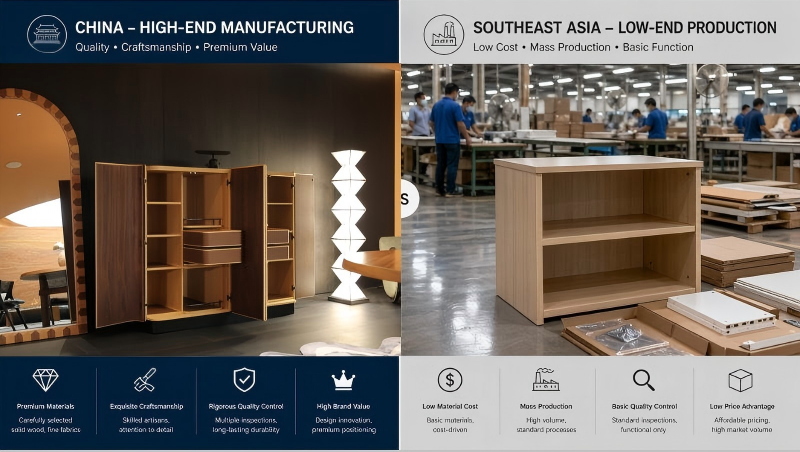
A significant trend in 2026 is the strategic relocation of production driven by shifts in US market demand.
Victor’s Expert Opinion: “We see many international buyers, especially for luxury villas and high-end residential projects, coming directly to China, bypassing traditional European brands. They know the quality is here. In Foshan, you see a boom of massive ‘new retail’ showrooms, integrating supply chains to offer one-stop sourcing for this high-end demand. But buyers must be cautious—not every shiny showroom is a capable manufacturer.”
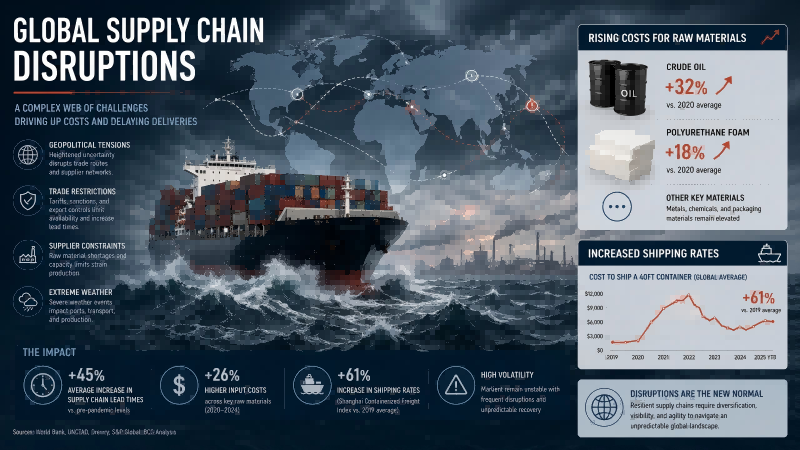
Global conflicts are having a direct and immediate impact on the furniture supply chain in 2026. The US-Iran conflict, in particular, has triggered a cascade of cost increases.
China’s prolonged real estate market downturn has created a challenging domestic environment. In response, a massive wave of manufacturers and dealers, who previously only focused on the domestic market, are now attempting to enter the export business. This presents both a tempting opportunity and a significant danger for international buyers.
Victor’s Expert Opinion: “On the surface, it looks like a buyer’s market. More suppliers mean more choice and, in theory, better negotiating power. However, the reality is a minefield. These ‘内销转外销’ (domestic-to-export) suppliers are dangerously inexperienced. Their understanding often ends at ‘Ex-Works’ pricing. They have no knowledge of export documentation, international packaging standards, customs clearance, or compliant payment procedures. What you see may be not what you get.”
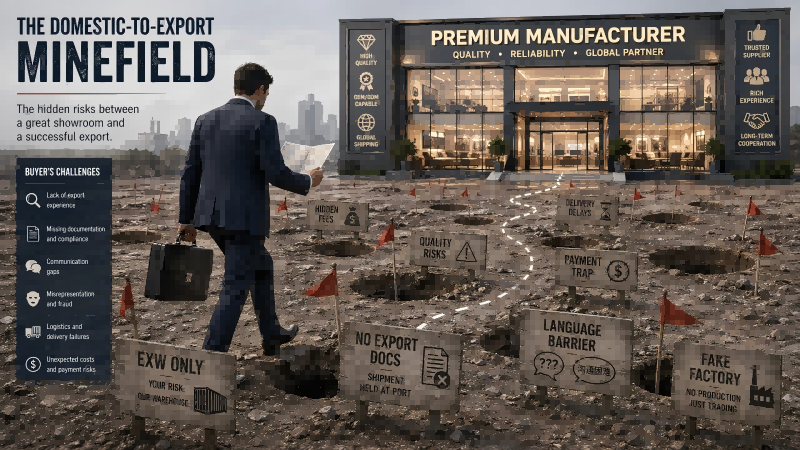
The market is now flooded with entities that are not what they appear to be:
| Attribute | Established Exporter (e.g., BMS FURNITURE) | ‘Domestic-to-Export’ Newcomer |
|---|---|---|
| Export Expertise | 20+ years of experience; understands all regulations, documentation, and logistics. | Zero to minimal. Often relies on the buyer to handle everything. |
| Quotation Terms | Provides clear EXW, FOB, CIF, DDP terms. Understands landed cost. | Typically only provides Ex-Works (EXW). Unfamiliar with shipping and insurance. |
| Quality & Compliance | Familiar with international standards (CARB, FSC). Robust internal QC process. | Quality may be inconsistent. Unaware of international compliance requirements. |
| Communication | Professional English-speaking team. Proactive problem-solving. | Language barriers are common. Communication may be reactive and unreliable. |
| Risk Level | Low. Proven track record and established processes. | High. Risk of delays, quality issues, and unexpected costs. |
In this chaotic market, the single most important decision a buyer can make is choosing the right partner. The difficulty of vetting suppliers has increased tenfold. A reliable, experienced exporter is no longer a luxury; it is a necessity.
BMS FURNITURE’s Commitment:
With over two decades of dedicated export experience, BMS’s foreign trade department has an intimate understanding of global markets, regulations, and logistics. We are not just a manufacturer; we are a strategic sourcing partner.
“Don’t navigate this market alone,” advises Victor. “The risks are too high. Talk to a professional team that has seen it all. At BMS, we provide the transparency and reliability that is missing from the market today. We handle the complexities so our clients can focus on their business.”
Q1: Is Vietnam a better place to source furniture than China in 2026?
A1: It depends on the product. For low-to-mid-end, high-volume items, Vietnam is a competitive alternative. For high-end, custom, or complex furniture, China’s mature supply chain and skilled workforce remain superior. Many Vietnamese factories are also run by Chinese suppliers.
Q2: How can I protect my business from rising material and shipping costs?
A2: Victor suggests, “Work with your supplier on transparent costing. Place orders further in advance to buffer against lead time volatility and book shipping containers early. For high-value orders, consider hedging strategies for currency and material costs.”
Q3: What are the red flags of an inexperienced ‘domestic-to-export’ supplier?
A3: Key red flags include: only offering EXW prices, being unable to discuss shipping or customs, poor English communication, having no international certifications, and pressuring for a deposit before clarifying all production and shipping details.
Q4: Is it safe to buy from a large showroom in Foshan?
A4: It can be, but you must verify if the showroom is the actual manufacturer or just a dealer. Ask for a factory tour, check their business license (to see if ‘manufacturing’ is in the scope), and ask for technical details that only a real factory would know.
Q5: Why choose a partner like BMS over sourcing directly from a new, cheaper factory?
A5: The perceived cost saving is often an illusion. An experienced partner like BMS mitigates risk, ensures compliance, manages complex logistics, and guarantees quality. The total landed cost and peace of mind provided by a professional exporter far outweigh the superficial savings offered by an unreliable supplier.
The China furniture industry of 2026 offers immense opportunities, but it is wrapped in layers of complexity and risk. The winning strategy is no longer about finding the lowest price, but about finding the most reliable and capable partner.
By understanding the market’s polarization, accounting for geopolitical cost factors, and rigorously vetting suppliers—especially the new wave of ‘domestic-to-export’ factories—B2B buyers can navigate this challenging landscape successfully. Or, they can partner with a trusted expert who already has.
Confused by the market chaos? Let’s talk. The BMS FURNITURE team is ready to bring clarity and reliability to your sourcing strategy.
Our furniture come from the minds of BMS' respected designers with more than 30 years' experience in the industry.
Get Free PlansBMS designers would love to add their imaginative but professional ideas to your design selection and customization.
Contact Now
BMS is always here to help you style the furniture you need, your way.
Be the first to get our latest styles and offers.
NO.9 Gegao Road,Gegao Industrial Park,Longjiang Town,Shunde District, Foshan, China
+86-13630170664
director@bms-f.com